
Insolvency and Bankruptcy in Pakistan
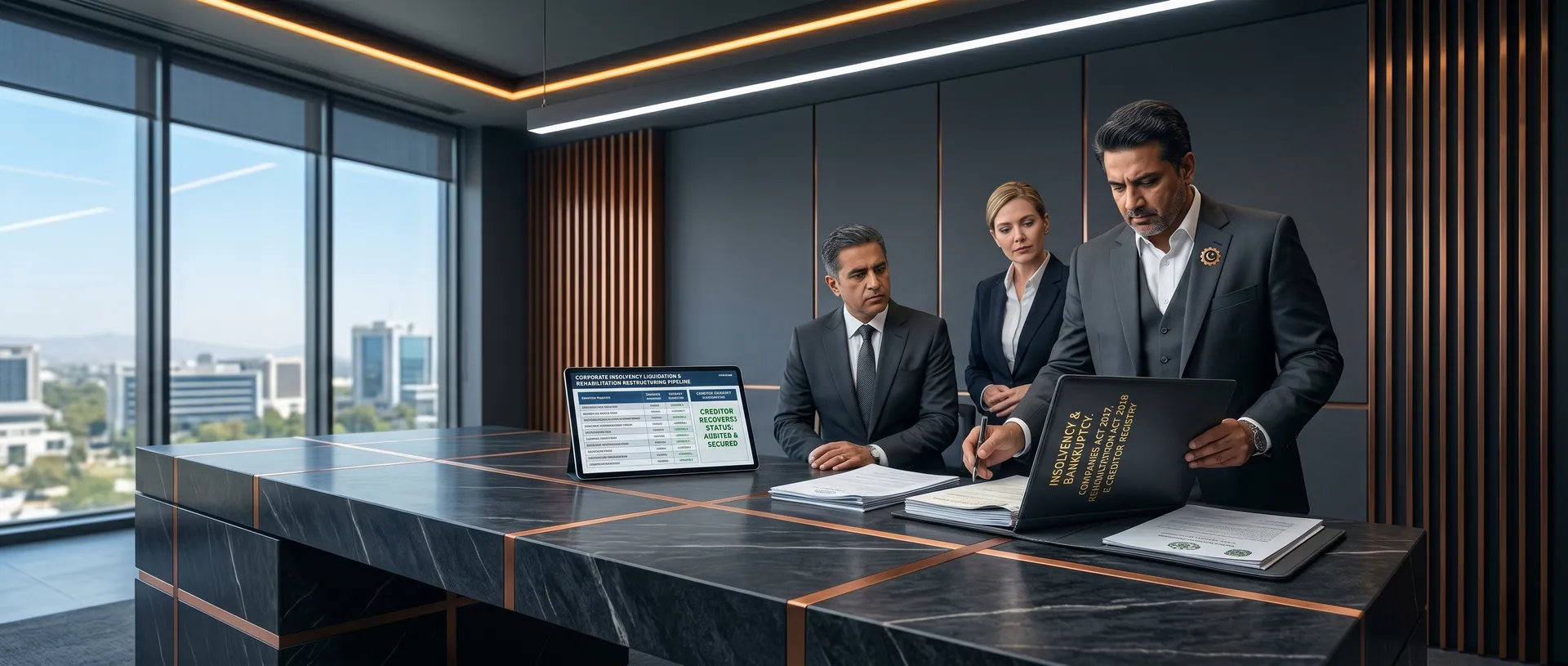
Pakistan law · reported authority · practical assessment
Insolvency and Bankruptcy: applicable law and case brief
What decides this service
Insolvency advice should map debts, security, assets, cash flow, creditor actions, directors' duties, and available restructuring or winding-up routes. Timing matters because value and control can disappear quickly after default.
Applicable Pakistani legal framework
These are the principal enactments to test at the start of a insolvency and bankruptcy matter. Amendments, rules, special regimes, and provincial application still depend on the facts and location.
- Corporate Rehabilitation Act 2018
- Provides a court-supervised rehabilitation route for distressed companies and arrangements with creditors.
- Insolvency Act 1920
- Provides insolvency procedures for individual debtors, creditor petitions, vesting, administration, and discharge.
- Companies Act 2017
- Governs incorporation, share capital, directors, member rights, filings, charges, restructuring, and winding up.
- Financial Institutions (Recovery of Finances) Ordinance 2001
- Provides the specialist Banking Court process and remedies for finance defaults by institutions and customers.
Statute titles checked in PakistanLawSite on 25 August 2026; descriptions are original editorial summaries.
Burki & Co v Director, Intelligence and Investigation (Customs)
2026 SCMR 1171
- Court
- Supreme Court of Pakistan
- Decided
- 27 October 2025
The legal question
Can a party reopen the same dispute through a different forum after a final constitutional decision?
What the Court held
No. The Court applied the doctrine of election of remedies and finality: once parties pursue a chosen remedy to a conclusive outcome, they cannot seek a second determination of the same question before a lower statutory forum.
Practical implication
Choosing the first forum is a substantive decision. A remedies map should be prepared before filing so an urgent step does not unintentionally foreclose the better statutory route.
What we establish first
- The government action, statute, rule, treaty, order, and complete record of earlier proceedings.
- Available remedies, jurisdictional limits, preconditions, limitation periods, and the consequences of electing one route.
- The constitutional, civil, administrative, or international relief actually available on the proved facts.
This is an original editorial summary of a reported decision verified in PakistanLawSite on 25 August 2026. It is a research starting point, not a prediction or legal advice; outcomes depend on the current law, evidence, and facts of each matter.
When a person or company cannot pay its debts, the law provides mechanisms to deal with the situation, to wind up an insolvent company and distribute its assets, to attempt the rehabilitation of a viable but distressed business, and to protect and enforce the rights of creditors. Insolvency is a difficult situation for debtors and creditors alike, and handling it requires both legal capability and commercial judgement. Global Law Company advises companies, creditors, and stakeholders across Pakistan on insolvency, winding up, corporate rehabilitation, and creditors' rights.
Insolvency matters bring competing interests into sharp focus, the debtor's, the creditors', and other stakeholders', and the legal framework provides the means to resolve them, whether through the orderly winding up of an insolvent business or the rescue of a viable one. We act for both debtors and creditors, bringing capability and judgement to these difficult situations.
The insolvency framework
Corporate insolvency in Pakistan is governed principally by the Companies Act 2017, which provides for the winding up of companies, by the court and voluntarily, and the related processes for dealing with an insolvent company's affairs, assets, and creditors, and by the Corporate Rehabilitation Act 2018, which provides a framework for the rehabilitation of distressed but potentially viable companies as an alternative to liquidation. The recovery of debts by financial institutions engages the specialised banking recovery framework, and the enforcement of debts generally engages the civil recovery and execution processes. Personal insolvency and the historic bankruptcy framework also exist. Understanding these mechanisms, winding up, rehabilitation, and recovery, and choosing the right one for the situation is central to insolvency practice.
Winding up and liquidation
The winding up of an insolvent company, the process by which the company's affairs are wound up, its assets realised, and the proceeds distributed to creditors before the company is dissolved, is the principal insolvency mechanism for a company that cannot be saved. We advise and act in winding-up matters under the Companies Act 2017, acting for creditors seeking to wind up a company that cannot pay its debts, for companies in the winding-up process, and for stakeholders affected by it. We advise on the grounds and process for winding up, on the conduct of the liquidation and the realisation and distribution of assets, and on the rights and priorities of creditors and other stakeholders in the process. Effective handling of a winding up, whether pursuing or responding to it, requires both the legal capability and the judgement to protect the client's interests, and we bring both.
Corporate rehabilitation and restructuring
Not every distressed company should be liquidated; where a business is potentially viable, rehabilitation or restructuring may preserve value for creditors and stakeholders better than liquidation, and the law provides a framework for this. We advise on corporate rehabilitation under the Corporate Rehabilitation Act 2018 and on the restructuring of distressed companies and their debts, acting for companies seeking to rehabilitate, for creditors involved in a rehabilitation, and on the negotiation and implementation of restructuring arrangements. Rehabilitation and restructuring can offer a better outcome than liquidation for a viable business and its creditors, and handling the framework and the negotiations effectively requires both legal and commercial capability. We bring both to help preserve value where a distressed business can be saved.
Creditors' rights and recovery
For creditors facing an insolvent or distressed debtor, the priority is protecting and enforcing their rights and recovering as much as possible, and the available routes depend on the situation and the creditor's position. We advise and act for creditors, secured and unsecured, in protecting and enforcing their rights against insolvent and distressed debtors, including through winding-up proceedings, participation in rehabilitation and restructuring, the enforcement of security, and the recovery and execution processes. We advise on the creditor's position and priorities and on the most effective route to recovery in the circumstances. Because the recovery available to a creditor often depends on acting effectively and on the creditor's position and priority, we bring the capability to protect and advance our creditor clients' interests in insolvency situations.
Distressed businesses and stakeholder advice
Insolvency and distress affect a range of stakeholders, the company and its directors, shareholders, creditors, employees, and others, each with interests and, in the case of directors, potential responsibilities and exposure, and we advise across these stakeholder positions. We advise distressed companies and their directors on their position, options, and responsibilities as insolvency approaches or arises, including the directors' duties and potential exposure in an insolvency, and we advise shareholders, creditors, and other stakeholders on protecting their interests. Handling distress and insolvency requires understanding the competing interests and the options available, and we bring that understanding to advising the various stakeholders, helping each protect their position and, where possible, achieve the best available outcome from a difficult situation.
How Global Law Company helps
We advise companies, creditors, and stakeholders across the whole of insolvency and bankruptcy, the framework and choice of mechanism, winding up and liquidation, corporate rehabilitation and restructuring, creditors' rights and recovery, and advice to distressed businesses and stakeholders. Because insolvency brings competing interests into focus and requires both legal capability and commercial judgement, we bring both, acting for debtors and creditors alike. Our focus is the orderly and effective resolution of insolvency situations and the protection of our clients' interests within them.
Why choose Global Law Company
Insolvency work rewards advisers who know the winding-up, rehabilitation, and recovery frameworks, can choose and pursue the right mechanism, and bring commercial judgement to competing interests, and clients value that we bring all of this for both debtors and creditors. We act in winding up, rehabilitation, and creditor recovery, and advise distressed businesses and stakeholders. For the difficult situations insolvency presents, that capability is exactly what is needed.
Talk to an insolvency lawyer in Pakistan
Speak with a lawyer at Global Law Company
Need help with Insolvency and Bankruptcy? Book a confidential consultation. Reach us directly and we will respond within 4 business hours.
Monday to Saturday, 9:00 AM to 6:00 PM
Frequently Asked Questions
Principally the Companies Act 2017 for winding up and the Corporate Rehabilitation Act 2018 for the rehabilitation of distressed companies, with the banking recovery and civil execution frameworks for debt recovery.
The process by which an insolvent company's affairs are wound up, its assets realised, and the proceeds distributed to creditors before the company is dissolved. We act for creditors, companies, and stakeholders in winding up.
A framework under the Corporate Rehabilitation Act 2018 for rescuing a distressed but viable company as an alternative to liquidation, preserving value for creditors and stakeholders. We advise on rehabilitation and restructuring.
Through winding-up proceedings, participation in rehabilitation, enforcement of security, and the recovery and execution processes, depending on the creditor's position and priority. We advise and act for creditors.
Understand their position, options, and responsibilities, including their duties and potential exposure as insolvency approaches. We advise distressed companies and their directors on handling the situation.
Related Civil, Constitutional and International services
View all→Further reading
In-depth guides from our legal team on closely related topics.