Litigation Practice in Pakistan
When a dispute cannot be resolved by agreement, litigation is the means by which rights are enforced and wrongs are remedied through the courts. Effective litigation is not merely about arguing in court; it is about strategy, preparation, evidence, and judgement, knowing which battles to fight, how to position a case, and when to settle. Global Law Company represents individuals, businesses, and institutions across Pakistan in civil and commercial litigation, from the trial courts through to the High Courts and the Supreme Court.
Litigation in Pakistan can be lengthy and demanding, and the difference between a well-run case and a poorly run one is often the difference between winning and losing. We bring rigorous preparation, sound strategy, and effective advocacy to every matter, always with a clear focus on the client's commercial or personal objective rather than litigation for its own sake.
The litigation framework
Civil litigation in Pakistan is governed principally by the Code of Civil Procedure 1908, which sets out the rules for the conduct of suits, appeals, and execution, together with the Qanun-e-Shahadat Order 1984 governing evidence, the Specific Relief Act 1877 for particular remedies, and the substantive law applicable to the dispute. Cases are heard through a hierarchy, the civil and district courts at first instance, the High Courts on appeal and in their original and constitutional jurisdiction, and the Supreme Court at the apex, with specialised forums for particular matters such as banking, rent, tax, and family. Understanding this framework and how to handle it is fundamental to effective litigation.
Civil and commercial litigation
We act in the full range of civil and commercial disputes, contract and commercial claims, recovery of money and debts, property and title disputes, partnership and shareholder disputes, and claims for damages, declarations, injunctions, and specific performance. For each, we assess the merits candidly, develop a strategy aimed at the client's objective, prepare the pleadings and evidence with care, and advocate the case effectively before the court. Because civil litigation turns heavily on procedure and evidence as well as substance, we pay close attention to getting the pleadings, the documents, and the witnesses right, which is often where cases are decided.
Strategy, interim relief, and case management
Litigation is won as much through strategy as through argument. We advise on the strongest way to frame and position a case, on the interim relief, injunctions, stay orders, and attachments, that can protect a client's position while the case proceeds, and on managing the case efficiently through a system that can otherwise be slow. We are equally alert to the opportunities to resolve a matter favourably without a full trial, through negotiation or settlement, where that serves the client better than continued litigation. Sound strategy and well-judged interim relief frequently shape the outcome long before final judgment.
Appeals and the superior courts
Many cases are ultimately decided on appeal, and effective appellate work is a distinct skill. We represent clients in appeals and revisions before the appellate courts, in the original and constitutional jurisdiction of the High Courts (including writ petitions against unlawful state action), and in appeals before the Supreme Court. Appellate litigation turns on the precise identification of the errors in the decision below and the persuasive presentation of legal argument, and we bring the rigour and advocacy that the superior courts require. We advise candidly on the prospects of an appeal so that clients make informed decisions about pursuing or resisting one.
Enforcement and execution
A judgment is only valuable if it can be enforced, and execution is often where unrepresented litigants falter. We pursue the execution of decrees, recovering money, possession, and other relief awarded, through the execution process, including the attachment and sale of property and the other coercive measures the law provides. We also act in resisting execution where it is improper. Seeing a case through to actual recovery, not just a paper judgment, is central to how we serve our clients, and we bring the same persistence to enforcement that we bring to the trial.
How Global Law Company helps
We represent clients across the whole of litigation, civil and commercial disputes, interim relief and strategy, trials, appeals through to the Supreme Court, and enforcement, for individuals, businesses, and institutions. Because litigation rewards preparation, strategy, and judgement, we bring all three, and because it should serve the client's objective, we keep that objective at the centre and pursue settlement where it serves the client. Our focus is winning the matter that actually matters to the client, efficiently and effectively.
Why choose Global Law Company
Litigation rewards advisers who combine rigorous preparation with sound strategy and effective advocacy, and who see the case through to enforcement, and clients value that we bring all of this. We assess merits honestly, frame cases strategically, secure interim relief, advocate persuasively at every level, and enforce what we win. For disputes that must be fought, that thorough capability is exactly what is needed.
Talk to a litigation lawyer in Pakistan
Alternative Dispute Resolution in Pakistan
Litigation is not the only, or always the best, way to resolve a dispute. Alternative dispute resolution (ADR) offers ways to settle disputes outside the courtroom: faster, more private, often cheaper, and frequently preserving the relationship between the parties. ADR encompasses negotiation, mediation, conciliation, and arbitration, and it is increasingly encouraged by the courts and chosen by parties who want a sensible resolution rather than years of litigation. Global Law Company advises and represents clients across Pakistan in all forms of alternative dispute resolution.
For many disputes, commercial, family, employment, and others, ADR achieves a better outcome than litigation: a resolution the parties can live with, reached in a fraction of the time. We help clients choose the right ADR method, conduct it effectively, and protect their interests throughout, while remaining ready to litigate if ADR does not succeed.
The ADR framework and its growing role
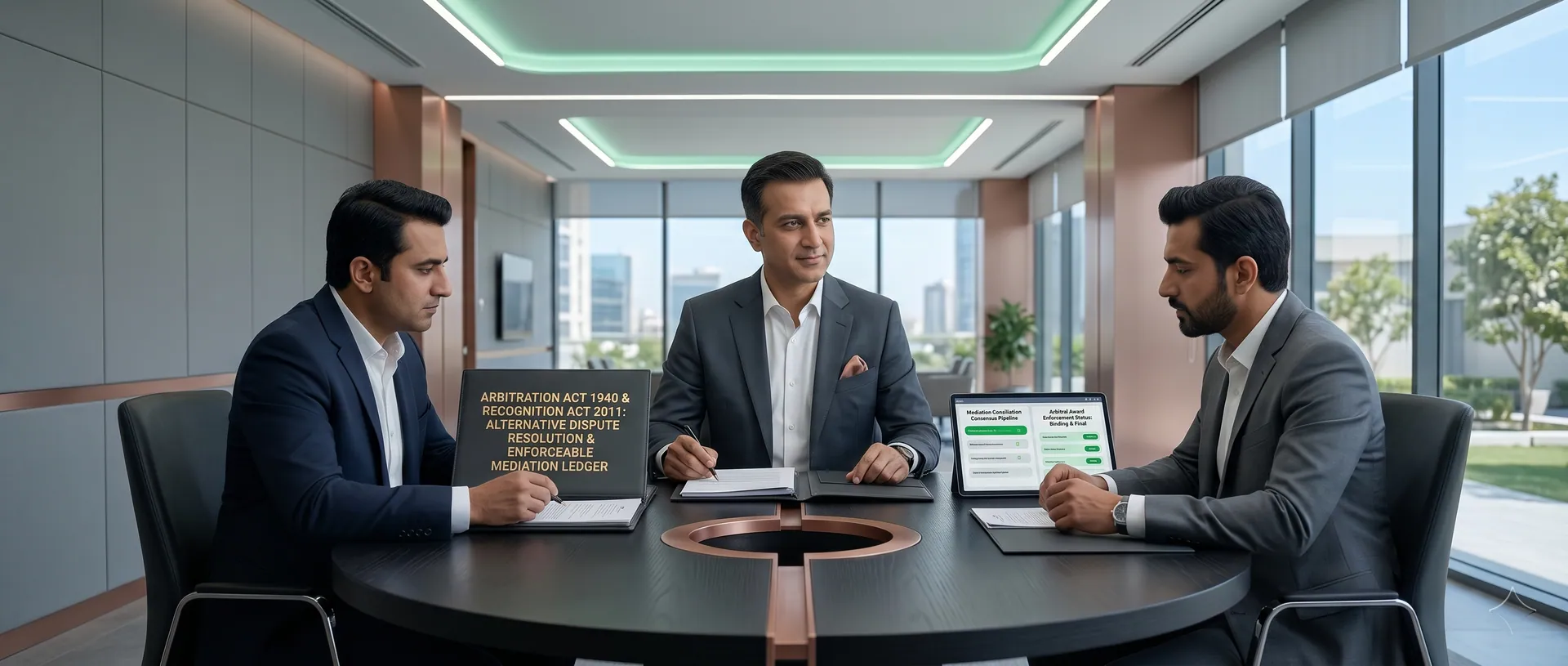
ADR in Pakistan operates through a combination of contract, statute, and court practice. Arbitration is governed by the Arbitration Act 1940 for domestic arbitration and the Recognition and Enforcement (Arbitration Agreements and Foreign Arbitral Awards) Act 2011 for international arbitration and foreign awards. Mediation and conciliation are increasingly embedded in court processes and specific laws, the courts encourage and, in some matters, require ADR, and family law mandates reconciliation efforts. Many commercial contracts now contain ADR clauses requiring negotiation, mediation, or arbitration before or instead of litigation. The result is a growing ADR landscape that parties and their lawyers can use to resolve disputes more efficiently.
Negotiation and settlement
The simplest and most common form of ADR is direct negotiation, and a well-conducted negotiation resolves many disputes without any formal process. We negotiate on behalf of clients in disputes of all kinds, bringing the use of a strong legal position and the judgement to know what a fair and achievable settlement looks like. We also document settlements properly, so that an agreement reached is enforceable and final rather than the seed of a further dispute. For many clients, a well-judged negotiated settlement, reached quickly and on good terms, is the best possible outcome, and we pursue it wherever it serves them.
Mediation and conciliation
Mediation and conciliation involve a neutral third party who helps the disputing parties reach their own agreement, without imposing a decision. These processes are particularly effective where the parties have an ongoing relationship to preserve, commercial partners, family members, or employer and employee, and where a negotiated, mutually acceptable outcome is preferable to a winner-takes-all judgment. We represent and advise clients in mediation and conciliation, preparing the case, advising on strategy, and protecting the client's interests in the process, and we draft the settlement agreements that result. Mediation can resolve in days or weeks what litigation might take years to decide.
Arbitration as an ADR method
Arbitration is the most formal ADR method, in which the parties agree to have their dispute decided by an arbitrator whose award is binding and enforceable. It is widely used in commercial and construction contracts and in international transactions, offering a private, often faster alternative to court with an enforceable result. We advise on arbitration agreements, represent clients in domestic and international arbitration, and handle the enforcement and challenge of awards, as detailed in our dedicated [arbitration](077-arbitration-law.md) practice. As an ADR method, arbitration combines the finality of a binding decision with the privacy and flexibility that parties often prefer over litigation.
Choosing and combining ADR methods
Different disputes suit different methods, and the right choice, or combination, can make a decisive difference. We advise clients on whether negotiation, mediation, conciliation, arbitration, or litigation best fits their dispute, taking account of the relationship, the stakes, the need for a binding result, and the cost and time involved. We also draft effective ADR clauses in contracts, so that future disputes are channelled into the most suitable process. Choosing the right path at the outset, and being prepared to escalate or change course as a dispute develops, is central to resolving it well, and we bring that strategic judgement.
How Global Law Company helps
We advise and represent clients across the full range of ADR, negotiation and settlement, mediation and conciliation, and arbitration, and we draft the ADR clauses that channel future disputes effectively. Because ADR can deliver faster, cheaper, and more relationship-preserving outcomes than litigation, we actively consider it for every dispute, while remaining fully equipped to litigate where ADR is not appropriate or does not succeed. Our focus is the most effective resolution of the client's dispute, by whatever path serves them best.
Why choose Global Law Company
ADR rewards advisers who can negotiate and mediate effectively, know when each method fits, and can escalate to arbitration or litigation when needed, and clients value that we bring all of this. We resolve disputes through well-judged negotiation and mediation, represent clients in arbitration, and draft sound ADR clauses. For clients who want a sensible resolution rather than a prolonged fight, that capability is exactly what is needed.
Talk to us about alternative dispute resolution in Pakistan
Arbitration Law in Pakistan
Arbitration is a private method of resolving disputes in which the parties agree to have their dispute decided by one or more arbitrators, whose award is final and binding. It is the dispute-resolution method of choice for many commercial and construction contracts and for international transactions, offering privacy, flexibility, the ability to choose decision-makers with relevant expertise, and, critically for cross-border deals, an award that is enforceable across many countries. Global Law Company advises and represents clients across Pakistan in domestic and international arbitration.
Arbitration combines the finality of a binding decision with advantages that litigation often cannot match, but its effectiveness depends on a sound arbitration agreement and skilled conduct of the process. We help clients build effective arbitration into their contracts, conduct arbitrations to a successful award, and enforce or challenge awards as the situation requires.
The arbitration framework in Pakistan
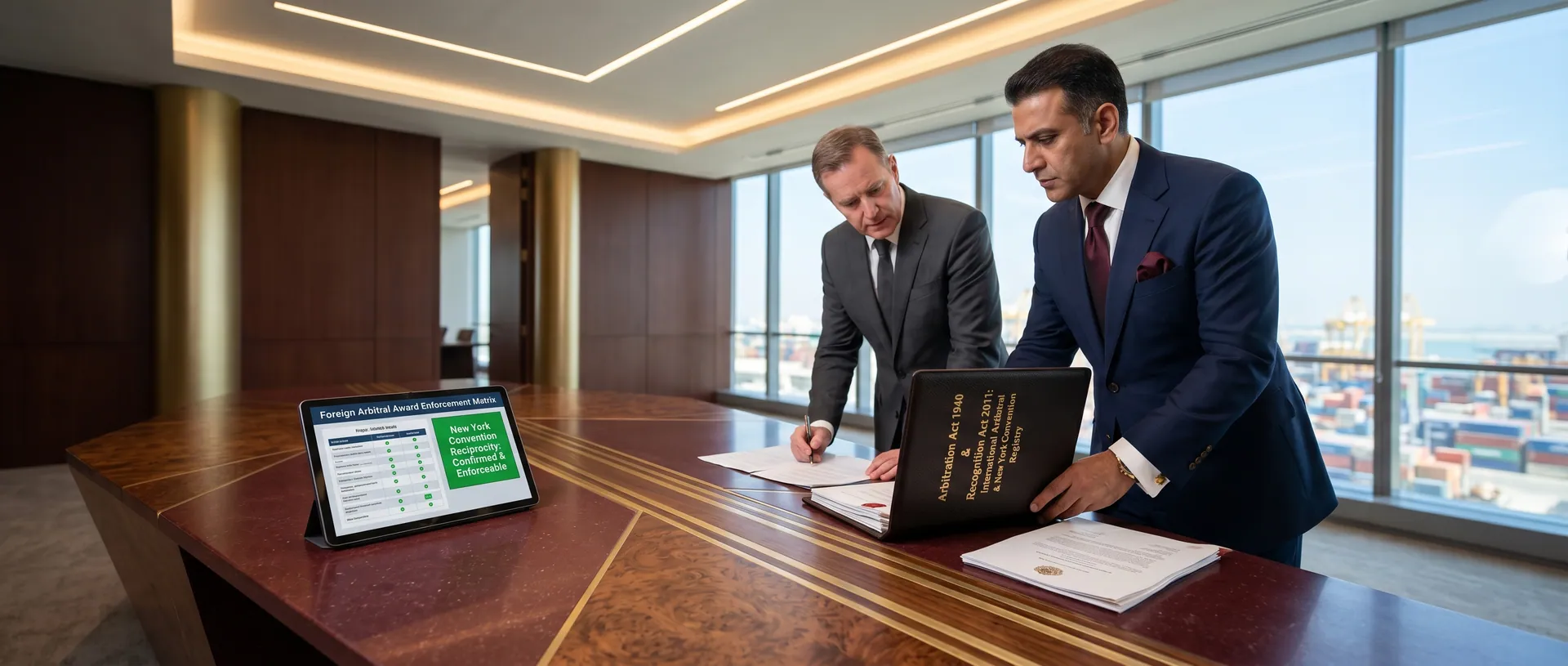
Domestic arbitration in Pakistan is governed by the Arbitration Act 1940, which provides for arbitration agreements, the conduct of arbitration, the making of awards, and the role of the courts in supporting and supervising the process and in making awards rules of court. International commercial arbitration and the enforcement of foreign arbitral awards are governed by the Recognition and Enforcement (Arbitration Agreements and Foreign Arbitral Awards) Act 2011, which gives effect to Pakistan's obligations under the New York Convention, allowing foreign awards to be recognised and enforced in Pakistan subject to limited grounds for refusal. Understanding the interplay between the arbitration process and the supervisory and enforcement role of the courts is central to effective arbitration practice.
Arbitration agreements and clauses
Arbitration begins with the agreement to arbitrate, and the quality of the arbitration clause shapes everything that follows. A well-drafted clause addresses the scope of disputes covered, the seat and governing law, the rules and the appointing authority, the number and selection of arbitrators, the language, and the relationship with the courts. A poorly drafted clause can lead to disputes about the arbitration itself, undermining the very efficiency arbitration is meant to provide. We draft and review arbitration clauses in commercial, construction, and international contracts to ensure they are effective and enforceable, so that if a dispute arises the parties have a clear, workable route to resolution.
Conducting domestic arbitration
We represent clients in domestic arbitrations under the Arbitration Act 1940, across commercial, construction, and other disputes. This includes advising on the commencement of arbitration, the constitution of the tribunal, the conduct of the proceedings and the presentation of the case and evidence, and the making of the award, as well as the court applications that arise, for the appointment of arbitrators, interim measures, and the filing and enforcement of the award. We bring the same rigour and advocacy to arbitration that we bring to litigation, while using the flexibility of the arbitral process to our client's advantage. Effective conduct of the arbitration is what secures a favourable, enforceable award.
International arbitration and foreign awards
For cross-border disputes, international arbitration is often the preferred forum precisely because awards are widely enforceable. We advise and represent clients in international arbitration connected with Pakistan, on the choice of seat, rules, and arbitrators, and on the conduct of the proceedings, coordinating with foreign counsel where required. Critically, we handle the recognition and enforcement of foreign arbitral awards in Pakistan under the 2011 Act, and we resist enforcement on the limited available grounds where we act for a party challenging an award. For international parties, the enforceability of an award in Pakistan is often the decisive consideration, and we bring the expertise to secure or resist it.
Challenging and enforcing awards
An arbitral award is intended to be final, but the law provides limited routes to challenge an award and a process for its enforcement. We act both for parties seeking to enforce an award, making it a rule of court and executing it to obtain the relief awarded, and for parties seeking to challenge or set aside an award on the limited grounds available, such as misconduct, excess of jurisdiction, or a defect in the process. Because the grounds for challenge are deliberately narrow, the enforcement of a sound award is generally the stronger position, and we pursue it effectively, while bringing genuine challenges where the grounds exist.
How Global Law Company helps
We advise and represent clients across the whole of arbitration, drafting effective arbitration agreements, conducting domestic and international arbitrations, and enforcing or challenging awards, including the recognition and enforcement of foreign awards under the 2011 Act. Because arbitration combines the finality of a binding result with privacy and flexibility, and because its effectiveness depends on the agreement and the conduct, we bring both the drafting and the advocacy capability it requires. Our focus is securing and enforcing favourable awards and protecting clients against adverse ones.
Why choose Global Law Company
Arbitration rewards advisers who draft sound arbitration agreements, conduct proceedings skilfully, and handle the enforcement and challenge of awards, including across borders, and clients value that we bring all of this. We build effective arbitration into contracts, represent clients in domestic and international arbitration, and enforce or resist awards under the applicable law. For commercial and cross-border disputes, that capability is exactly what is needed.
Talk to an arbitration lawyer in Pakistan
Mediation in Pakistan
Mediation is a voluntary, confidential process in which a neutral mediator helps disputing parties reach their own agreement, rather than having a decision imposed on them. It is one of the most effective ways to resolve a dispute quickly, privately, and in a way that preserves relationships, and it is increasingly central to the resolution of commercial, family, and civil disputes in Pakistan, encouraged by the courts and chosen by parties who want a sensible outcome. Global Law Company advises and represents clients in mediation across Pakistan.
The power of mediation lies in its focus on interests rather than positions: a skilled mediation can find solutions that a court, bound to choose between the parties' stated cases, cannot. We help clients use mediation effectively, preparing the case, advising on strategy, and protecting their interests, to reach settlements that genuinely serve them.
The role of mediation in Pakistan
Mediation in Pakistan is increasingly embedded in the legal system and in commercial practice. The courts encourage and, in some matters, refer parties to mediation, and certain processes, such as the reconciliation required in family matters, are mediation-like in character. Court-annexed and institutional mediation centres have developed, and many commercial contracts now include mediation as a required step before arbitration or litigation. Mediation is also a recognised component of the broader alternative dispute resolution framework. The result is that mediation is a real and growing option for resolving disputes, and parties and their lawyers can use it deliberately to achieve faster, better outcomes.
How mediation works
In a mediation, a neutral mediator facilitates discussion between the parties, helping them understand each other's interests, explore options, and reach a mutually acceptable agreement. The mediator does not impose a decision; the outcome is the parties' own, which is why settlements reached in mediation tend to be durable and to preserve relationships. The process is confidential, so parties can explore settlement without prejudicing their position if mediation fails, and it is flexible, allowing creative solutions. We prepare clients thoroughly for mediation, clarifying their interests and objectives, assessing the realistic range of outcomes, and developing a strategy, so that they enter the process well positioned to achieve a good result.
Mediation in commercial and civil disputes
Commercial and civil disputes are particularly well suited to mediation, especially where the parties have an ongoing relationship to preserve or where the cost, delay, and uncertainty of litigation make a negotiated settlement attractive. We represent businesses and individuals in mediating contract, commercial, property, partnership, and other civil disputes, bringing the use of a strong legal position and the judgement to identify a settlement that serves the client. Even where litigation has begun, mediation can often resolve the matter far more quickly and cheaply than continuing to judgment, and we actively consider it as a route to a better outcome for our clients.
Family and sensitive disputes
Family disputes are among those where mediation is most valuable, because the relationships involved, between spouses, parents, and family members, often need to continue, particularly where children are involved. Mediation allows family disputes over custody, maintenance, financial matters, and separation to be resolved more amicably and privately than contested litigation, and Pakistani family procedure itself incorporates reconciliation efforts. We represent and advise clients in family mediation with the sensitivity these matters require, helping them reach arrangements that work for the family and, above all, serve the welfare of any children. A mediated family settlement is frequently far less damaging than a courtroom battle.
Documenting and enforcing mediated settlements
A mediation succeeds only if the agreement reached is properly documented and effective, and this is where legal involvement is essential. We draft the settlement agreements that result from mediation so that they are clear, thorough, and enforceable, turning the parties' understanding into a binding resolution rather than a fragile handshake. Where appropriate, a settlement can be given further effect through the court, making it readily enforceable. Proper documentation is what ensures that the time and goodwill invested in mediation produce a final resolution rather than the basis for a further dispute, and we bring the drafting rigour to secure that.
How Global Law Company helps
We advise and represent clients in mediation across commercial, civil, and family disputes, preparing the case and strategy, representing the client's interests in the process, and drafting enforceable settlement agreements. Because mediation can deliver faster, cheaper, and more relationship-preserving outcomes than litigation, we actively consider it for suitable disputes, while remaining ready to litigate or arbitrate where mediation is not appropriate or does not succeed. Our focus is using mediation to achieve settlements that genuinely serve our clients.
Why choose Global Law Company
Mediation rewards advisers who prepare thoroughly, represent the client's interests skilfully in the process, and document the outcome enforceably, and clients value that we bring all of this with the right judgement about when mediation fits. We position clients well for mediation, help them reach good settlements, and make those settlements binding. For disputes where a negotiated resolution serves the client best, that capability is exactly what is needed.
Talk to a mediation lawyer in Pakistan