E-Commerce Law in Pakistan
E-commerce has transformed how business is done, with online stores, marketplaces, and digital services reaching customers directly and at scale. But selling online brings a distinct set of legal requirements, around contracts and terms, consumer protection, data and privacy, payments, and the cross-border nature of much online trade, that an offline business does not face in the same way. Global Law Company advises online businesses, marketplaces, and digital ventures across Pakistan on the full range of e-commerce legal matters.
E-commerce sits at the intersection of contract, consumer, data, payment, and intellectual-property law, and a successful online business needs all of these foundations in place. We help e-commerce ventures set up and operate lawfully, protect themselves and their customers, and manage the issues that online trade generates.
The e-commerce legal framework
E-commerce in Pakistan is governed not by a single statute but by a combination of laws applied to the online context. The formation and enforceability of online contracts and the legal recognition of electronic transactions and signatures are addressed by the Electronic Transactions Ordinance 2002. Consumer dealings online engage the consumer-protection framework and the rules on deceptive marketing. Online conduct and offences engage the Prevention of Electronic Crimes Act 2016 (PECA). Payments and the handling of customer funds engage the State Bank of Pakistan's regulation of electronic and digital payments. The handling of customer data engages the developing data-protection framework. And the general law of contract, intellectual property, and tax applies to online business as to any other. A successful e-commerce business must handle all of these together.
Setting up and structuring an online business
We advise e-commerce ventures on setting up and structuring their business for online trade, the choice of entity and the corporate and tax structure, the arrangements for selling directly or operating a marketplace connecting third-party sellers and buyers, and the registrations and compliance the business requires. The structure of an e-commerce business, particularly a marketplace, raises specific questions about the relationships and liabilities among the platform, sellers, and buyers, and getting these right at the outset is important. We help online businesses build a sound structure and put in place the foundations, corporate, tax, and regulatory, on which a compliant online venture depends.
Terms, consumer protection, and disclosures
The terms on which an online business deals with its customers are central to its legal protection and its compliance, and clear, fair, and compliant terms are essential. We draft the documentation an e-commerce business needs, website and platform terms of use, terms and conditions of sale, return, refund, and warranty policies, and the disclosures consumer protection requires, tailored to the business and compliant with the consumer-protection and electronic-transactions framework. For marketplaces, we also draft the seller and buyer agreements that govern the platform. Clear, fair, and compliant terms protect the business against disputes and regulatory issues while giving customers the confidence that drives online trade, and we draft them to achieve both.
Data protection, privacy, and payments
Online businesses collect and handle significant customer data and process payments, and both raise important legal requirements. We advise e-commerce businesses on the handling of customer personal data in compliance with the developing data-protection framework, on privacy policies and data practices, and on the security and handling of payment and financial information, and we advise on the regulatory dimension of online payments under the State Bank of Pakistan's framework, including arrangements with payment providers. As data protection and payment regulation develop, online businesses must keep their practices compliant, and we help them do so. We address these areas further in our [data protection](104-data-protection-privacy.md) and [fintech and payments](105-fintech-payments-law.md) practices.
Disputes, IP, and cross-border issues
E-commerce generates disputes and raises intellectual-property and cross-border issues that online businesses must manage. We advise on and handle consumer disputes and complaints, disputes between platforms and sellers, and the protection of the business's brand and content and against infringing and counterfeit goods sold online, and we address the cross-border dimension of online trade, including sales to and from abroad and the applicable law and enforcement. Online businesses face these issues at scale and at speed, and managing them, through sound terms, effective dispute handling, and brand protection, is central to operating successfully. We bring the combined commercial, consumer, IP, and dispute capability that e-commerce requires.
How Global Law Company helps
We advise online businesses, marketplaces, and digital ventures across the whole of e-commerce law, the regulatory framework, business setup and structuring, terms and consumer compliance, data and payments, and disputes, IP, and cross-border issues. Because e-commerce draws together many areas of law, we bring the combined capability an online business needs to operate lawfully and protect itself and its customers. Our focus is sound legal foundations and effective protection for our clients' online ventures.
Why choose Global Law Company
E-commerce work rewards advisers who can bring together contract, consumer, data, payment, and IP law in the online context, and clients value that we provide that combined capability. We set up and structure online businesses, draft compliant terms and policies, advise on data and payments, and handle disputes and brand protection. For a business operating online, that integrated capability is exactly what is needed.
Talk to an e-commerce lawyer in Pakistan
Electronic Contracts (E-Contracts) in Pakistan
Business is increasingly conducted electronically, with agreements negotiated, concluded, and signed online rather than on paper. Electronic contracts, formed by email, on websites and apps, and through electronic signatures, are now central to commerce, but their validity and enforceability depend on meeting the legal requirements for electronic transactions. Global Law Company advises businesses across Pakistan on the drafting, validity, and enforceability of electronic contracts and on the use of electronic and digital signatures.
The convenience of contracting electronically is matched by the need to ensure that what is concluded online is legally valid and enforceable, and that the electronic processes used will stand up if a contract is questioned. We help businesses contract electronically with confidence, ensuring their e-contracts and signatures are sound.
The legal framework for electronic transactions
Electronic contracts and signatures in Pakistan are given legal recognition by the Electronic Transactions Ordinance 2002, which provides that information, documents, and signatures are not denied legal effect merely because they are in electronic form, and which establishes the framework for electronic signatures and the certification framework for advanced electronic signatures. The general law of contract under the Contract Act 1872 continues to govern the substance of the agreement, offer, acceptance, consideration, capacity, and the rest, applied to the electronic context. Certain transactions may still require particular formalities or may be excepted, and understanding which transactions can be validly concluded electronically, and how, is central to using e-contracts effectively. We advise on this framework and its application.
Validity and enforceability of e-contracts
The central question with any electronic contract is whether it is validly formed and enforceable, and this depends on satisfying both the general law of contract and the requirements for electronic transactions. We advise businesses on the validity and enforceability of their electronic contracts, how offer and acceptance are validly made and communicated electronically, how an electronic agreement satisfies the requirements of a contract, and what is needed for the e-contract to be enforceable and provable. We also advise on the transactions for which electronic conclusion may not be appropriate or may require particular care. Ensuring that an electronically concluded contract is valid and enforceable, rather than vulnerable to challenge, is the foundation of contracting online, and we help businesses achieve it.
Electronic and digital signatures
Electronic signatures are central to e-contracts, and their legal effect depends on meeting the requirements the framework provides, with advanced or certified electronic signatures carrying particular evidentiary weight. We advise businesses on the use of electronic and digital signatures, the different types of electronic signature and their legal effect, the use of the certification framework for advanced electronic signatures, and the practices that ensure a signature is valid and a signed e-contract is provable and enforceable. As businesses adopt electronic signing for efficiency, ensuring that the signatures used will be recognised and will hold up if a contract is questioned is essential, and we advise on the approach that gives the necessary legal certainty.
Drafting contracts for electronic conclusion
Contracts intended to be concluded and performed electronically benefit from being drafted with that in mind, addressing the electronic formation, signing, and performance and the issues these raise. We draft and adapt contracts for electronic conclusion, including click-wrap and browse-wrap arrangements on websites and apps, electronic execution of commercial agreements, and the terms governing electronic communications and notices, so that the agreement is sound in the electronic context. For businesses moving their contracting online, well-drafted e-contracts that anticipate the electronic process protect them and reduce the risk of disputes about the validity or terms of an agreement concluded electronically. We bring the drafting capability to make electronic contracting reliable.
E-contracts in disputes and evidence
When an electronic contract is disputed, questions arise about its formation, terms, and the integrity and admissibility of the electronic records and signatures, and these evidentiary questions can be decisive. We advise on and act in disputes involving electronic contracts, on establishing the formation and terms of an e-contract and the integrity of the electronic records and signatures, and on the evidentiary issues that electronic agreements raise, drawing on the electronic-transactions framework and the law of evidence. Because the enforceability of an e-contract may ultimately be tested in a dispute, building and preserving the record that proves the contract is important, and we advise businesses on this and represent them in e-contract disputes. Sound practices at the contracting stage make disputes far easier to win.
How Global Law Company helps
We advise businesses across the whole of electronic contracting, the legal framework, the validity and enforceability of e-contracts, electronic and digital signatures, the drafting of contracts for electronic conclusion, and e-contract disputes and evidence. Because the convenience of electronic contracting depends on legal validity and provability, we bring the capability to help businesses contract electronically with confidence and to defend their e-contracts if challenged. Our focus is reliable, enforceable electronic contracting for our clients.
Why choose Global Law Company
E-contract work rewards advisers who understand both the electronic-transactions framework and the general law of contract and evidence, and clients value that we bring all of this. We ensure e-contracts are valid and enforceable, advise on electronic signatures, draft contracts for electronic conclusion, and handle e-contract disputes. For businesses contracting electronically, that capability is exactly what is needed.
Talk to us about electronic contracts in Pakistan
Data Protection and Privacy in Pakistan
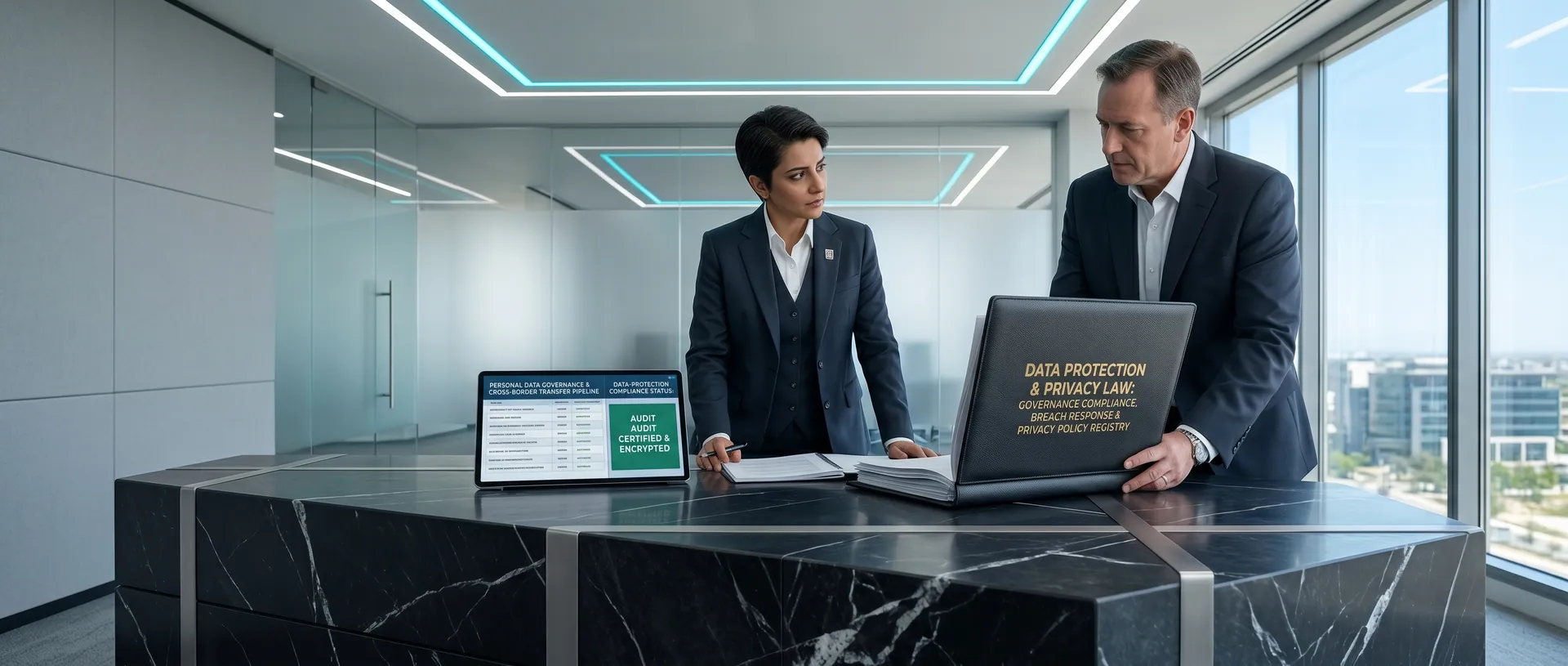
Data is central to the modern economy, and the personal data that businesses collect about their customers, employees, and users carries growing legal responsibility. Data protection and privacy law governs how personal data may be collected, used, stored, shared, and protected, and compliance has become a significant concern for businesses, particularly those operating online, handling large volumes of data, or dealing internationally. Global Law Company advises businesses across Pakistan on data protection and privacy compliance, data handling, and the developing legal framework.
The data-protection landscape in Pakistan is developing, with growing regulation and increasing expectations from customers, partners, and international counterparties. Businesses that build sound data practices now protect themselves against legal risk and meet the expectations on which their relationships increasingly depend. We help clients understand their obligations, build compliant data practices, and manage data issues and breaches.
The data protection framework in Pakistan
Data protection and privacy in Pakistan rest on a developing framework. The constitutional right to privacy provides a foundation, and specific protections arise under various laws, including the provisions of the Prevention of Electronic Crimes Act 2016 (PECA) addressing the unauthorised use and disclosure of data and identity information, and sectoral rules in areas such as banking, telecommunications, and health. Pakistan has been developing dedicated data-protection legislation, and the framework is expected to continue to strengthen and align more closely with international data-protection standards. In addition, businesses dealing with customers and partners abroad are often subject to, or contractually required to meet, international data-protection standards. We advise on the current framework and help businesses prepare for its continued development.
Data compliance and governance
Sound data protection begins with understanding what personal data a business holds and how it is handled, and building the governance and practices that compliance requires. We advise businesses on data governance and compliance, mapping the personal data they collect and process, the legal basis and purposes for processing, how data is stored, secured, retained, and shared, and the rights of the individuals whose data is held. We help businesses build the policies, practices, and controls that demonstrate compliance and protect the data they hold. As the framework develops and expectations rise, establishing sound data governance is increasingly important, and we help businesses put it in place proportionately to their size and the data they handle.
Privacy policies, notices, and consents
Businesses that collect personal data must be transparent about how they use it and, where required, obtain consent, and the documentation that achieves this is central to data compliance. We draft the data-protection documentation businesses need, privacy policies and notices, consent mechanisms, cookie and tracking notices for websites and apps, and the data-protection terms in contracts with customers, employees, and service providers. Clear, accurate privacy documentation both meets the transparency requirements and builds the trust on which data-driven relationships depend. For online businesses in particular, sound privacy policies and consent practices are essential, and we draft them to be both compliant and practical.
Data sharing, processors, and cross-border transfers
Businesses share personal data with service providers, partners, and group companies, and increasingly transfer it across borders, and these arrangements raise specific data-protection requirements. We advise businesses on data-sharing and data-processing arrangements, including the data-protection terms and agreements with service providers and partners who handle data on the business's behalf, and on the requirements for transferring personal data abroad, which is a particular focus of data-protection regimes. As businesses rely on cloud services, outsourcing, and international operations, getting these data-sharing and transfer arrangements right is central to compliance, and we advise on and document them to meet the applicable requirements and any contractual standards imposed by international counterparties.
Data breaches and enforcement
Despite precautions, data breaches occur, and how a business responds, both practically and legally, is critical to limiting the harm and the legal exposure. We advise businesses on preparing for and responding to data breaches, including the response steps, any notification obligations, and the management of the legal and reputational consequences, and we advise on the enforcement and liability risks that data mishandling and breaches can create under the developing framework, PECA, and contractual obligations. A prepared, well-managed response to a data breach can significantly limit its consequences, and we help businesses both prepare for breaches and respond effectively when they occur, protecting them against the legal and reputational fallout.
How Global Law Company helps
We advise businesses across the whole of data protection and privacy, the developing framework, data compliance and governance, privacy policies and consents, data sharing and cross-border transfers, and data breaches and enforcement. Because the data-protection landscape is developing and the expectations are rising, we help businesses build sound, proportionate data practices now and prepare for the framework's continued strengthening. Our focus is compliant, well-governed data handling that protects our clients and the data they hold.
Why choose Global Law Company
Data-protection work rewards advisers who understand the developing framework and the practical realities of data handling, and who can build proportionate compliance, and clients value that we bring all of this. We establish data governance, draft privacy documentation, advise on data sharing and transfers, and manage breaches. For businesses handling personal data in a developing legal landscape, that capability is exactly what is needed.
Talk to a data protection lawyer in Pakistan
E-Governance Law in Pakistan
E-governance, the use of information and communication technology to deliver government services, administer the state, and interact with citizens and businesses, is transforming how the public sector operates and how the private sector deals with it. From electronic records and digital identity to online regulatory portals and digital public services, this shift creates new legal questions about electronic records, authentication, data, and the rights and obligations of those who use and provide digital government services. Global Law Company advises public-sector bodies, technology providers, and businesses across Pakistan on the legal dimensions of e-governance and digital government.
As government and regulation move online, both the public bodies delivering digital services and the businesses and citizens interacting with them need to understand the legal framework that governs electronic administration. We advise on this developing area, helping clients handle the legal questions that digital government raises.
The e-governance legal framework
E-governance in Pakistan rests on a developing framework drawing on several sources. The legal recognition of electronic records, documents, and signatures, fundamental to digital government, is provided by the Electronic Transactions Ordinance 2002. The handling of data and the security of government and citizen information engage the developing data-protection framework and cybersecurity considerations, and offences against information systems engage the Prevention of Electronic Crimes Act 2016 (PECA). Digital identity and records are administered through bodies such as NADRA, and the various government departments and regulators increasingly operate online portals and systems for registration, filing, and services. Administrative law governs the actions of public bodies whether they act on paper or electronically. Together, these provide the legal environment for e-governance.
Electronic records, authentication, and digital identity
At the heart of e-governance are electronic records and the authentication of identity and transactions, and the legal validity and integrity of these are central to digital government. We advise on the legal recognition and integrity of electronic government records, on electronic authentication and signatures in the context of digital services, and on the legal questions around digital identity and its use in accessing services and conducting transactions. As government records and services move online, ensuring that electronic records are legally valid and that authentication is sound is essential both for the public bodies operating these systems and for the businesses and citizens relying on them, and we advise on these foundational questions.
Digital government services and the private sector
The private sector interacts with e-governance both as a user of digital government services, online registration, filing, licensing, tax, and other portals, and as a provider of the technology and systems behind digital government (govtech). We advise businesses on their dealings with digital government services and on the legal issues that arise, and we advise technology providers on the contracts, compliance, data, and liability questions involved in delivering systems and services to government. For technology businesses in the govtech space, the contracts and obligations involved in serving the public sector are distinctive, and we bring the combined technology, contract, and public-law capability these arrangements require, helping providers and users handle digital government effectively.
Data, security, and citizen rights
E-governance involves the handling of large volumes of citizen and business data and the operation of critical public information systems, raising significant data-protection, security, and rights questions. We advise on the data-protection and security dimensions of digital government, on the handling of citizen and business data in electronic government systems, and on the rights of those whose data is held and who interact with digital services. As government digitalises, the protection of the data it holds and the security of its systems become increasingly important, both legally and for public trust, and we advise public bodies and their technology partners on meeting these obligations and on the legal questions that the handling of government-held data and the rights of citizens raise.
Administrative law in the digital context
The actions of public bodies, including their decisions made and communicated through digital systems, remain subject to administrative law and the requirements of lawful, fair, and reasonable administration, and the move online does not change these fundamentals. We advise businesses and individuals on the administrative-law dimension of their dealings with digital government, challenging unlawful or unfair decisions made through digital systems, addressing problems with online portals and processes that affect their rights, and ensuring that digital administration respects the legal requirements that apply to public bodies. The digitalisation of government does not diminish the rights of those it affects, and we help clients assert those rights in the digital context, connecting e-governance with our broader administrative-law and constitutional practice.
How Global Law Company helps
We advise public-sector bodies, technology providers, and businesses across the dimensions of e-governance, the legal framework, electronic records and digital identity, digital government services and govtech, data and security, and administrative law in the digital context. Because e-governance draws together electronic-transactions, data, technology, and public law, we bring the combined capability this developing area requires. Our focus is helping clients handle the legal questions of digital government, whether they deliver, support, or rely on digital public services.
Why choose Global Law Company
E-governance work rewards advisers who can bring together electronic-transactions, data, technology, and administrative law in the context of digital government, and clients value that we provide that combined capability. We advise on electronic records and identity, govtech contracts and compliance, data and security, and administrative-law issues. For a developing area at the meeting point of technology and the state, that integrated capability is exactly what is needed.
Talk to us about e-governance law in Pakistan