
Energy and Power Projects in Pakistan
Pakistan law · reported authority · practical assessment
Energy and Power Projects: applicable law and case brief
What decides this service
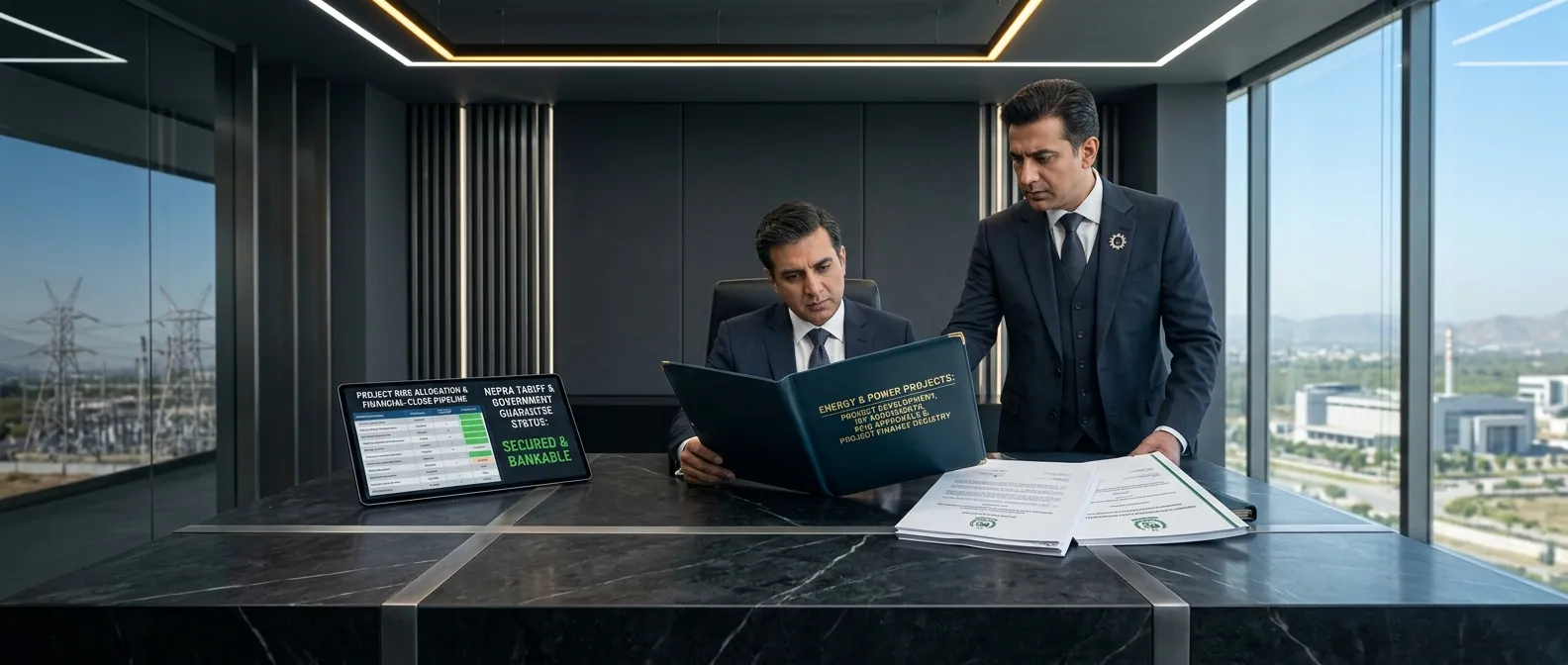
A power project should align land, grid, fuel, EPC, financing, offtake, permits, and regulatory approvals against a single completion timetable. A delay in one approval can change the commercial allocation across the project.
Applicable Pakistani legal framework
These are the principal enactments to test at the start of a energy and power projects matter. Amendments, rules, special regimes, and provincial application still depend on the facts and location.
- Regulation of Generation Transmission and Distribution of Electric Power Act 1997
- Establishes NEPRA's licensing, tariff, standards, market, complaint, and enforcement framework for electric power.
- Pakistan Environmental Protection Act 1997
- Provides the federal environmental standards, assessment, pollution-control, enforcement, and tribunal framework, with provincial counterparts after devolution.
- Contract Act 1872
- Sets the rules for formation, capacity, consent, performance, breach, damages, indemnity, guarantee, and agency.
- Land Acquisition Act 1894
- Provides the notification, objection, award, possession, compensation, and reference framework for public acquisition.
Statute titles checked in PakistanLawSite on 25 August 2026; descriptions are original editorial summaries.
Faisalabad Electricity Supply Company (FESCO) v Tariq Shahzad Weaving Factory
2026 SCMR 645
- Court
- Supreme Court of Pakistan
- Decided
- 16 October 2023
The legal question
Can a consumer bypass the statutory NEPRA review and appellate process by filing a constitutional petition over tariff adjustments?
What the Court held
The Court treated the statutory regulatory route as the proper path for the tariff disputes before it, allowing the appeals on agreed terms and leaving NEPRA to decide reserved matters independently under law.
Practical implication
Regulatory matters turn on the decision-maker and statutory pathway. Before approaching a court, identify the licence, determination, review, appellate remedy, and record that the specialist regulator must consider.
What we establish first
- The applicable licence, concession, tariff, determination, environmental approval, or sector-specific regulatory instrument.
- Technical reports, invoices, inspection material, compliance history, and the decision or notice being challenged.
- The regulator’s review path, appellate forum, limitation period, and any project or operational risk requiring urgent action.
This is an original editorial summary of a reported decision verified in PakistanLawSite on 25 August 2026. It is a research starting point, not a prediction or legal advice; outcomes depend on the current law, evidence, and facts of each matter.
Developing an energy or power project is among the most complex undertakings in commercial law, a long-term, capital-intensive venture involving sponsors, lenders, off-takers, contractors, and the government, bound together by a suite of interlocking agreements and dependent on regulatory approvals and government support. Getting the structure, the contracts, and the approvals right is what makes a project bankable and viable over its decades-long life. Global Law Company advises sponsors, investors, lenders, and developers across Pakistan on the development, structuring, and documentation of energy and power projects.
A power project succeeds or fails on its legal and contractual foundations: a single weak link in the chain of project agreements, or a gap in the regulatory or government-support arrangements, can render a project unfinanceable. We bring the capability to structure and document these projects soundly, coordinating the many strands that an energy project involves.
The project framework and participants
An energy or power project in Pakistan typically involves a project company (often an independent power producer, or IPP), its sponsors and investors, lenders providing project finance, an off-taker purchasing the output, fuel or resource suppliers, engineering and construction contractors, operators, and the government and regulators. The framework engages NEPRA regulation and licensing and tariff determinations, the Private Power and Infrastructure Board and the Alternative Energy Development Board for power and renewable projects, the Board of Investment, and the foreign-investment and foreign-exchange regime. The project is held together by a suite of agreements among these participants and supported by government guarantees and assurances. Understanding this framework and how the participants and agreements fit together is the foundation of project work.
Project structuring and development
The structuring of a project, how the project company is owned and financed, how risk is allocated among the participants, and how the project is supported by the government and regulators, determines its bankability and viability. We advise sponsors and investors on structuring energy and power projects, including the project company, the ownership and investment structure, the allocation of the project risks (construction, operation, fuel/resource, off-take, and political risk), and the regulatory and government-support arrangements. Sound structuring, undertaken early, is what allows a project to attract investment and finance and to withstand the long-term risks it faces. We bring the structuring capability that bankable energy projects require.
The suite of project agreements
An energy project is documented through a suite of interlocking agreements, each of which must fit with the others and allocate risk soundly. These typically include the implementation or concession agreement with the government, the power-purchase agreement (or equivalent off-take agreement) with the off-taker, the fuel-supply or resource agreement, the engineering, procurement, and construction (EPC) contract, the operation-and-maintenance agreement, the connection and transmission arrangements, and the financing and security documents. We draft and negotiate these project agreements, with close attention to the allocation of risk across the suite and the consistency of the agreements with one another and with the regulatory and government-support framework. The quality and coherence of this documentation is what makes a project financeable and protects the sponsors over its life. We address the off-take dimension further in our [power purchase agreements](100-power-purchase-agreements.md) practice.
Financing, approvals, and government support
Energy projects depend on project finance and on a range of regulatory approvals and government support, and securing these is central to reaching financial close and beginning construction. We advise on the financing of energy projects, including the lenders' requirements, the security package, and the conditions to financial close, and we coordinate the regulatory approvals, NEPRA licensing and tariff, PPIB or AEDB processes, and other consents, and the government guarantees and support the project requires. Reaching financial close on a power project is a major milestone that depends on the alignment of the financing, the project agreements, the approvals, and the government support, and we work to bring these strands together so the project can proceed.
Disputes and the life of the project
Energy projects run for decades, and disputes can arise at any stage, during construction (delay and defects under the EPC contract), in operation (under the off-take, supply, and OandM agreements), over tariffs and regulatory matters, and over payments and government obligations. We advise on managing and resolving project disputes through the dispute-resolution mechanisms in the project agreements, including arbitration, and we represent project participants in these disputes. Because project disputes can threaten the viability of a long-term, high-value project, managing them effectively, and building sound dispute-resolution mechanisms into the agreements from the outset, is central to protecting the project. We bring both the transactional and the dispute capability the life of a project requires.
How Global Law Company helps
We advise sponsors, investors, lenders, and developers across the whole life of energy and power projects, structuring and development, the suite of project agreements, financing, approvals, and government support, and project disputes. Because these projects are complex, long-term, and dependent on the alignment of many strands, we bring the combined regulatory, transactional, finance, and dispute capability they require, coordinating with technical and financial advisers and lenders' counsel. Our focus is bankable, well-documented projects that withstand their long-term risks.
Why choose Global Law Company
Power-project work rewards advisers who can structure projects, draft and align the suite of project agreements, coordinate financing and government support, and handle disputes, and clients value that we bring all of this. We deliver the structuring, documentation, and approvals that make projects bankable, and we protect them through their life. For complex, long-term energy projects, that thorough capability is exactly what is needed.
Talk to a power project lawyer in Pakistan
Speak with a lawyer at Global Law Company
Need help with Energy and Power Projects? Book a confidential consultation. Reach us directly and we will respond within 4 business hours.
Monday to Saturday, 9:00 AM to 6:00 PM
Frequently Asked Questions
An independent power producer, a privately owned project company that generates electricity and sells it, typically under a long-term power-purchase agreement. We advise sponsors and investors in developing IPPs.
A suite including the implementation/concession agreement, power-purchase agreement, fuel or resource supply agreement, EPC contract, OandM agreement, connection arrangements, and financing documents. We draft and align these.
Sound structuring, a coherent suite of project agreements allocating risk properly, the necessary approvals and government support, and a viable financing and security package. We work to bring these together.
Generally NEPRA licensing and a tariff, PPIB or AEDB processes for power and renewable projects, and other consents and government support. We coordinate these approvals.
Yes. We advise on and resolve disputes arising during construction, operation, and over tariffs and payments, through the project agreements' mechanisms including arbitration, and we represent project participants.