
Customs Law in Pakistan
Pakistan law · reported authority · practical assessment
Customs Law: applicable law and case brief
What decides this service
Customs exposure turns on classification, valuation, origin, exemption, import policy, declarations, and the actual goods record. Preserve the complete import file before replying to a show-cause notice or challenging a seizure.
Applicable Pakistani legal framework
These are the principal enactments to test at the start of a customs law matter. Amendments, rules, special regimes, and provincial application still depend on the facts and location.
- Customs Act 1969
- Governs import and export declarations, classification, valuation, duty, seizure, adjudication, and appeals.
- Sales Tax Act 1990
- Regulates federal sales tax on goods, registration, invoices, input tax, returns, audits, recovery, and refunds.
- Income Tax Ordinance 2001
- Governs taxable income, returns, withholding, assessments, recovery, refunds, appeals, and cross-border income-tax rules.
Statute titles checked in PakistanLawSite on 25 August 2026; descriptions are original editorial summaries.
Worldcall Telecom Ltd v Commissioner of Income Tax
2026 SCMR 663
- Court
- Supreme Court of Pakistan
- Decided
- 11 November 2025
The legal question
Can a business be treated as a taxpayer in default for not collecting advance tax from an intermediary?
What the Court held
Not on these facts. The Court held that the person from whom advance tax is collected must be the identifiable person entitled to claim its credit; the franchisees in the case could not claim that credit.
Practical implication
A withholding or collection dispute turns on the actual transaction flow, the identified taxpayer, and the statutory route for credit—not merely on the label attached to a payment.
What we establish first
- Contracts, invoices, ledgers, returns, certificates, and the transaction-to-taxpayer flow.
- The statutory section, tax year, notice, limitation position, and the authority that issued the demand.
- Recovery exposure and the correct objection, appeal, or stay strategy before the next deadline.
This is an original editorial summary of a reported decision verified in PakistanLawSite on 25 August 2026. It is a research starting point, not a prediction or legal advice; outcomes depend on the current law, evidence, and facts of each matter.
Customs law governs the movement of goods across Pakistan's borders, the duties payable on imports and exports, the classification and valuation of goods, and the rules that determine whether a consignment clears smoothly or is detained, seized, or penalised. For importers, exporters, and trading businesses, customs is a constant operational reality and a frequent source of costly disputes. Global Law Company advises traders and businesses across Pakistan on customs compliance, clearance, and disputes under the Customs Act 1969.
A customs problem can stop a business in its tracks, a detained consignment, a disputed valuation, or a penalty can tie up goods and capital and disrupt supply. We help businesses move goods compliantly and resolve customs disputes quickly, so trade keeps flowing.
The customs framework in Pakistan
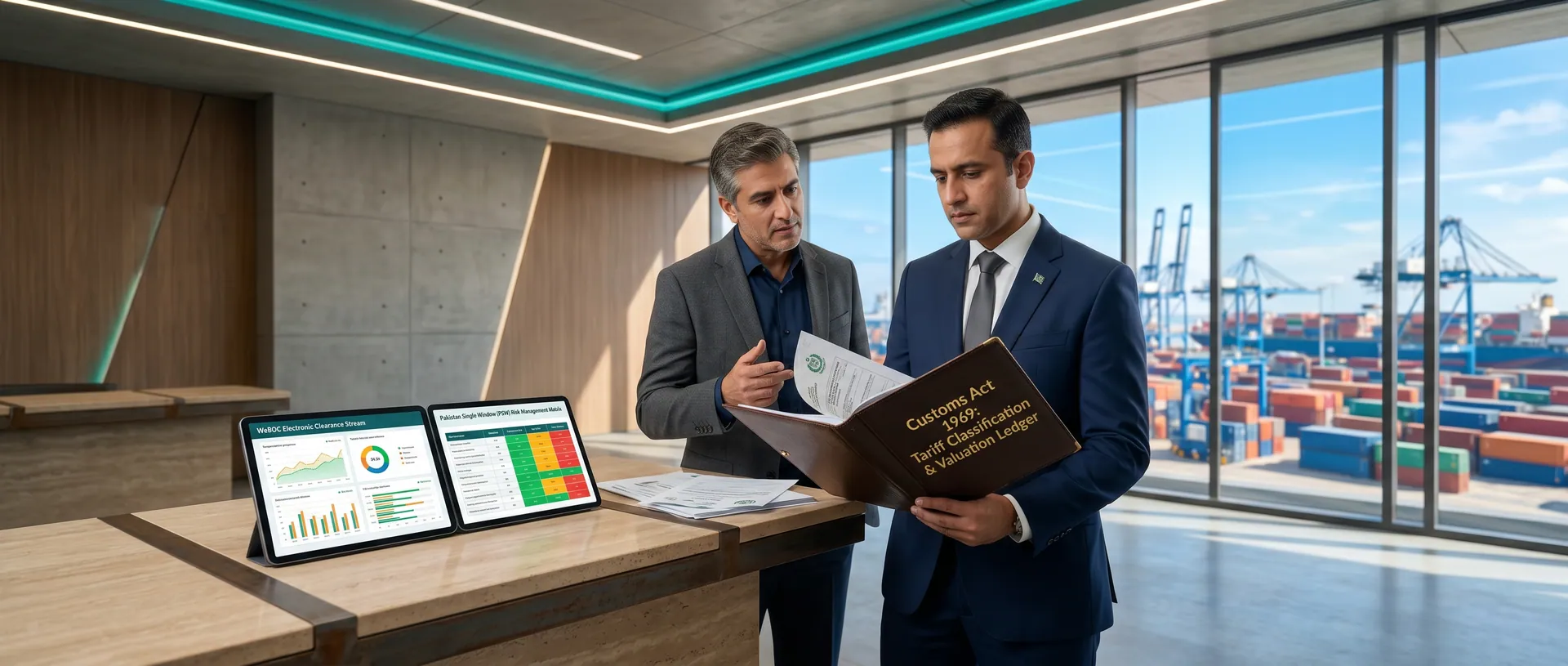
Customs in Pakistan is governed by the Customs Act 1969, administered by Pakistan Customs under the FBR, with clearance processed through the electronic WeBOC and Pakistan Single Window (PSW) systems. The Act provides for the levy and assessment of customs duties, the classification of goods under the tariff (based on the Harmonized System), the valuation of imported goods, exemptions and concessions under the tariff and Statutory Regulatory Orders (SROs), and the powers of customs officers to examine, detain, seize, and confiscate goods and to impose penalties. It also provides a structured appeal process. Customs interacts with sales tax and federal excise on imports, so the three are often assessed together at the import stage.
Classification and valuation
Two technical questions drive most customs disputes: the classification of goods under the tariff, which determines the rate of duty, and the customs value, which determines the amount on which duty is charged. Misclassification and disputed valuation, particularly where customs rejects the declared transaction value in favour of a higher assessed value, are among the most common and consequential customs disputes. We advise importers on the correct classification and valuation of their goods, contest misclassification and excessive valuation, and represent businesses before the customs valuation and classification authorities. Getting these right materially affects the duty cost and the smoothness of clearance.
Clearance, detentions, and seizures
When a consignment is detained, seized, or held up over a documentation, valuation, or classification issue, the priority is rapid resolution to release the goods and limit the cost of delay and demurrage. We act quickly for businesses facing detained or seized consignments, engaging with customs to secure release, resolving the underlying issue, and challenging unlawful detentions and seizures. We also advise on the confiscation and redemption provisions of the Act and on the penalties that customs can impose, working to minimise both the delay and the liability.
Penalties, offences, and disputes
The Customs Act provides for penalties and, in serious cases, prosecution for offences such as smuggling, misdeclaration, and evasion of duty. We defend businesses and individuals against customs penalties and offences, advise on the show-cause and adjudication process, and contest penalties that are disproportionate or wrongly imposed. Because customs offences can carry serious consequences, including confiscation and prosecution, early and informed engagement is essential, and we bring both the technical knowledge and the advocacy to defend our clients effectively.
Appeals, refunds, and concessions
Where a customs dispute cannot be resolved at the assessment or adjudication stage, the Act provides for appeal, to the Collector (Appeals), the Customs Appellate Tribunal, and onward to the High Court and Supreme Court on questions of law. We represent businesses at every level, pursuing appeals on classification, valuation, penalty, and procedural issues. We also advise on customs refunds where excess duty has been paid, and on the exemptions, concessions, and duty-drawback and rebate schemes available under the tariff and SROs, helping businesses claim the relief to which they are entitled.
How Global Law Company helps
We act for traders and businesses across the whole customs spectrum, classification and valuation, clearance and detentions, penalties and offences, and appeals and refunds, coordinated with their sales tax and excise obligations at the import stage. Because we combine customs knowledge with litigation capability and an understanding of the trade, we can both keep goods moving and defend businesses effectively in the disputes customs so often generates. Our focus is rapid resolution and the protection of the business's position.
Why choose Global Law Company
Customs work rewards advisers who understand the Act, the tariff, and the practical realities of clearance, and who can act fast when goods are held, and clients value that we bring all three. We resolve detentions quickly, contest misclassification and excessive valuation, defend penalties, and pursue appeals and refunds. For importers and exporters whose business depends on goods moving, that combination of speed and technical depth is exactly what is needed.
Talk to a customs lawyer in Pakistan
Speak with a lawyer at Global Law Company
Need help with Customs Law? Book a confidential consultation. Reach us directly and we will respond within 4 business hours.
Monday to Saturday, 9:00 AM to 6:00 PM
Frequently Asked Questions
The Customs Act 1969, administered by Pakistan Customs under the FBR, with clearance processed through the WeBOC and Pakistan Single Window systems.
Act quickly. We engage with customs to secure release, resolve the underlying valuation, classification, or documentation issue, and challenge unlawful detentions and seizures.
A dispute where customs rejects the declared value of imported goods in favour of a higher assessed value, increasing the duty. We contest excessive valuation and represent businesses before the valuation authorities.
Yes. You can appeal to the Collector (Appeals), the Customs Appellate Tribunal, and onward to the higher courts on questions of law. We represent businesses at every level.
Yes. The tariff and SROs provide exemptions, concessions, and duty-drawback and rebate schemes, and excess duty is refundable. We help businesses claim the relief they are entitled to.
Related Taxation and Revenue services
View all→Further reading
In-depth guides from our legal team on closely related topics.