
Alternative Dispute Resolution in Pakistan
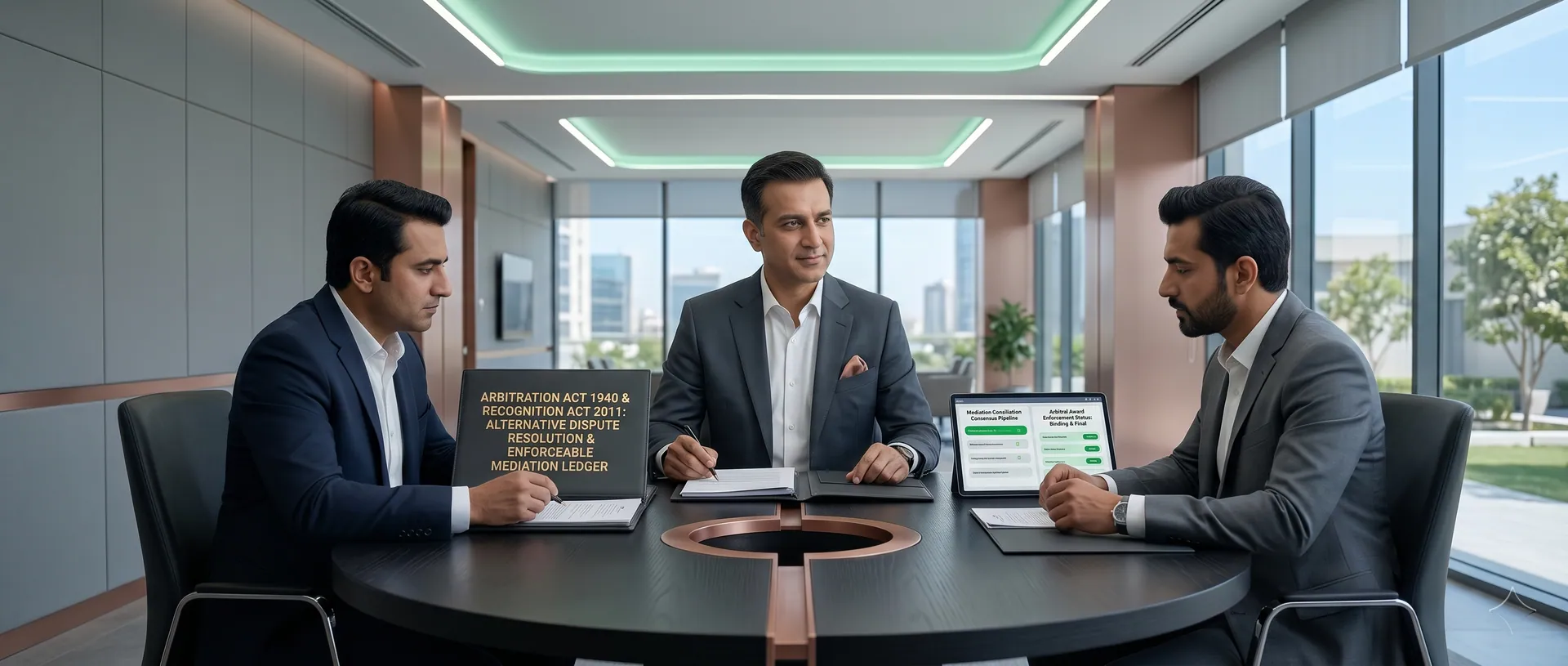
Litigation is not the only, or always the best, way to resolve a dispute. Alternative dispute resolution (ADR) offers ways to settle disputes outside the courtroom: faster, more private, often cheaper, and frequently preserving the relationship between the parties. ADR encompasses negotiation, mediation, conciliation, and arbitration, and it is increasingly encouraged by the courts and chosen by parties who want a sensible resolution rather than years of litigation. Global Law Company advises and represents clients across Pakistan in all forms of alternative dispute resolution.
For many disputes, commercial, family, employment, and others, ADR achieves a better outcome than litigation: a resolution the parties can live with, reached in a fraction of the time. We help clients choose the right ADR method, conduct it effectively, and protect their interests throughout, while remaining ready to litigate if ADR does not succeed.
The ADR framework and its growing role
ADR in Pakistan operates through a combination of contract, statute, and court practice. Arbitration is governed by the Arbitration Act 1940 for domestic arbitration and the Recognition and Enforcement (Arbitration Agreements and Foreign Arbitral Awards) Act 2011 for international arbitration and foreign awards. Mediation and conciliation are increasingly embedded in court processes and specific laws, the courts encourage and, in some matters, require ADR, and family law mandates reconciliation efforts. Many commercial contracts now contain ADR clauses requiring negotiation, mediation, or arbitration before or instead of litigation. The result is a growing ADR landscape that parties and their lawyers can use to resolve disputes more efficiently.
Negotiation and settlement
The simplest and most common form of ADR is direct negotiation, and a well-conducted negotiation resolves many disputes without any formal process. We negotiate on behalf of clients in disputes of all kinds, bringing the use of a strong legal position and the judgement to know what a fair and achievable settlement looks like. We also document settlements properly, so that an agreement reached is enforceable and final rather than the seed of a further dispute. For many clients, a well-judged negotiated settlement, reached quickly and on good terms, is the best possible outcome, and we pursue it wherever it serves them.
Mediation and conciliation
Mediation and conciliation involve a neutral third party who helps the disputing parties reach their own agreement, without imposing a decision. These processes are particularly effective where the parties have an ongoing relationship to preserve, commercial partners, family members, or employer and employee, and where a negotiated, mutually acceptable outcome is preferable to a winner-takes-all judgment. We represent and advise clients in mediation and conciliation, preparing the case, advising on strategy, and protecting the client's interests in the process, and we draft the settlement agreements that result. Mediation can resolve in days or weeks what litigation might take years to decide.
Arbitration as an ADR method
Arbitration is the most formal ADR method, in which the parties agree to have their dispute decided by an arbitrator whose award is binding and enforceable. It is widely used in commercial and construction contracts and in international transactions, offering a private, often faster alternative to court with an enforceable result. We advise on arbitration agreements, represent clients in domestic and international arbitration, and handle the enforcement and challenge of awards, as detailed in our dedicated [arbitration](077-arbitration-law.md) practice. As an ADR method, arbitration combines the finality of a binding decision with the privacy and flexibility that parties often prefer over litigation.
Choosing and combining ADR methods
Different disputes suit different methods, and the right choice, or combination, can make a decisive difference. We advise clients on whether negotiation, mediation, conciliation, arbitration, or litigation best fits their dispute, taking account of the relationship, the stakes, the need for a binding result, and the cost and time involved. We also draft effective ADR clauses in contracts, so that future disputes are channelled into the most suitable process. Choosing the right path at the outset, and being prepared to escalate or change course as a dispute develops, is central to resolving it well, and we bring that strategic judgement.
How Global Law Company helps
We advise and represent clients across the full range of ADR, negotiation and settlement, mediation and conciliation, and arbitration, and we draft the ADR clauses that channel future disputes effectively. Because ADR can deliver faster, cheaper, and more relationship-preserving outcomes than litigation, we actively consider it for every dispute, while remaining fully equipped to litigate where ADR is not appropriate or does not succeed. Our focus is the most effective resolution of the client's dispute, by whatever path serves them best.
Why choose Global Law Company
ADR rewards advisers who can negotiate and mediate effectively, know when each method fits, and can escalate to arbitration or litigation when needed, and clients value that we bring all of this. We resolve disputes through well-judged negotiation and mediation, represent clients in arbitration, and draft sound ADR clauses. For clients who want a sensible resolution rather than a prolonged fight, that capability is exactly what is needed.
Talk to us about alternative dispute resolution in Pakistan
Speak with a lawyer at Global Law Company
Need help with Alternative Dispute Resolution? Book a confidential consultation. Reach us directly and we will respond within 4 business hours.
Monday to Saturday, 10:00 AM to 6:00 PM
Frequently Asked Questions
Ways of resolving disputes outside the courtroom, negotiation, mediation, conciliation, and arbitration, that are often faster, cheaper, and more private than litigation, and can preserve relationships.
For many disputes, yes, particularly where speed, privacy, cost, or an ongoing relationship matters. But some disputes need litigation. We advise on the best path for your situation.
In mediation, a neutral helps the parties reach their own agreement; in arbitration, an arbitrator decides the dispute with a binding, enforceable award. We advise on and conduct both.
Yes. A properly documented settlement is enforceable, and arbitral awards are binding and enforceable, including foreign awards under the 2011 Act. We ensure outcomes are enforceable.
Often yes. A well-drafted ADR clause channels future disputes into the most suitable process. We draft effective negotiation, mediation, and arbitration clauses for contracts.
Related Dispute Resolution and Litigation services
View all→Further reading
In-depth guides from our legal team on closely related topics.