
Court Marriage in Pakistan: Process, Documents and Legality

Written by Muhammad Adeel Chaudhry, Senior Partner
Published
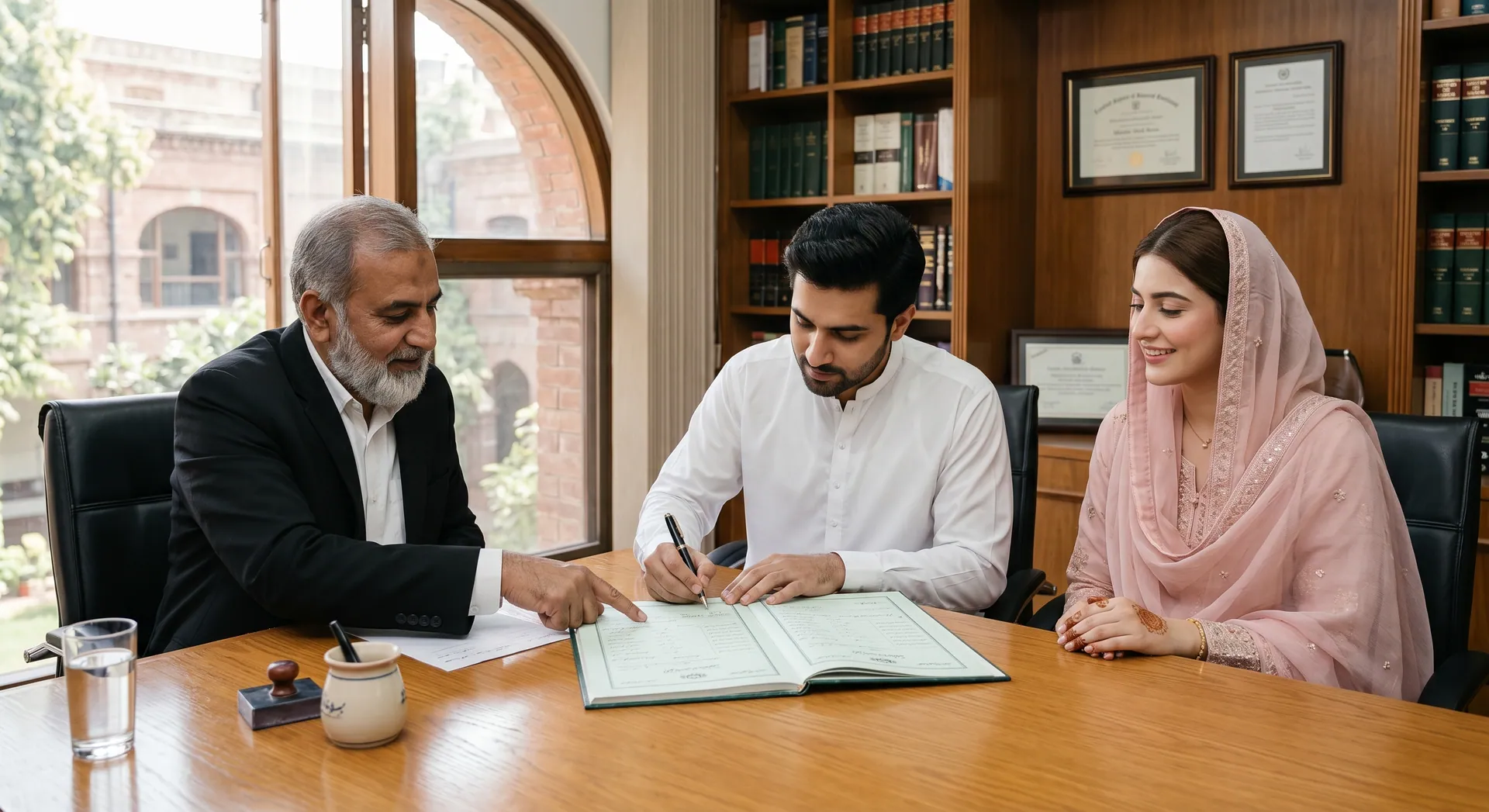
A court marriage is a lawful marriage solemnised and registered with proper legal documentation, often chosen by couples who marry of their own free will without a large family ceremony. In Pakistan, an adult Muslim man and woman of sound mind have the legal right to marry by their free consent, and that marriage is valid when conducted as a proper nikah and registered. This guide from Global Law Company explains the process, the documents you need, and how we protect couples through it, discreetly and lawfully, anywhere in the country.
Couples choose a court marriage for many reasons: family opposition, the wish to avoid a costly ceremony, a need to formalise a relationship quickly, or simply a preference for privacy. Whatever the reason, the priority is the same, that the marriage is legally watertight and that both spouses are protected from later challenge.
Is Court Marriage Legal in Pakistan?
Yes. A marriage between consenting adults is legal and recognised in Pakistan. Pakistani courts have repeatedly upheld that a sui juris (adult, of sound mind) woman can marry of her own free will, and such a marriage cannot be invalidated merely because the family did not consent. The key requirements are a valid nikah performed according to the parties' personal law and registration of the marriage under the law applicable in the relevant province. Free and informed consent of both parties is essential; a marriage procured by coercion is a different matter entirely, and underage marriage is unlawful.
The Court Marriage Process
In practice, the nikah is solemnised before a Nikah Registrar (or in the presence of witnesses and then reported for registration), the Nikahnama is completed and signed, and the marriage is entered in the official record. The Nikahnama and the later computerized certificate are related but different documents; our guide to Nikahnama registration in Pakistan explains who keeps the record and how to obtain a certificate or certified copy. Where couples are concerned about safety or family opposition, legal advice may also be needed on documentary evidence and protective remedies.
Documents Required
Couples should bring valid CNICs (and the relevant identity documents), passport-size photographs, and witnesses. Where a party was previously married, proof of the earlier marriage's dissolution, such as a divorce certificate or a death certificate, is needed. We confirm the exact list for your circumstances before the appointment so nothing delays the registration. Having the paperwork complete in advance is the simplest way to avoid an awkward postponement.
Protecting Your Marriage Legally
The most common problems after a court marriage are challenges by family members and the absence of proper documentation. We make sure the Nikah Nama is correctly completed and registered, prepare affidavits of free-will marriage, and advise on protective petitions to the High Court where there is a genuine threat to a couple's safety or liberty. Proper paperwork at the start prevents painful disputes later, including baseless complaints that are sometimes filed against couples by disapproving relatives, which a properly documented marriage helps to defeat.
Confidentiality and Safety
We understand that for some couples a court marriage carries real risk, and discretion is not a luxury but a necessity. We keep your matter confidential, advise sensibly on practical safety, and, where the threat is serious, help you seek the protection the courts can provide. Our aim is that you begin your marriage on secure legal footing, with the documents and, if needed, the court orders that put your status beyond doubt.
After the Marriage: Updating Your Records
A court marriage does not end at the signing of the Nikah Nama. To enjoy the full legal benefits of marriage, the couple should make sure the marriage is reflected in their official records. This typically means obtaining the registered Nikah Nama and, where required, a computerised marriage registration certificate, and updating each spouse's records with NADRA so that the marital status on the CNIC and the family registration is correct. These steps matter for practical reasons that surface later, applying for a spouse visa, opening joint accounts, claiming inheritance, nominating a beneficiary, or registering the birth of a child all run more smoothly when the marriage is properly documented from the outset. We guide couples through these post-marriage formalities so nothing is left half-finished.
Common Misconceptions About Court Marriage
Several myths cause needless worry. Some believe a court marriage is somehow "less valid" than a traditional ceremony, it is not; a properly conducted and registered nikah is fully valid regardless of the scale of celebration. Others fear that a marriage without family consent can be undone by relatives; in fact, the free consent of two adults is what the law protects, and disapproval alone does not invalidate the marriage. A further misconception is that registration is optional; while a valid nikah creates the marriage, registration is what gives you readily provable evidence of it, which is invaluable if the marriage is ever questioned. We help couples separate the real legal requirements from the rumours.
Get Confidential Help Anywhere in Pakistan
If you are planning a court marriage and want it done lawfully and discreetly, talk to us first. Contact Global Law Company, an experienced family lawyer in Pakistan, at 0333 4125951 or globallawcompany@gmail.com, or visit our family law chambers at 3rd Floor, Ahmad and Shafi Plaza, 13 Fane Rd, Lahore, 54000.
Frequently Asked Questions
Is court marriage legal without family consent?
Yes. An adult of sound mind can marry by free consent, and the marriage is valid even without family approval, as confirmed by Pakistani courts.
What documents are needed for a court marriage?
Typically CNICs, photographs, witnesses, and proof of dissolution of any prior marriage. We confirm the precise list for your case.
Is a Nikah Nama enough, or must the marriage be registered?
The marriage should be properly registered in the official record. Registration provides essential legal proof and protects both spouses.
Can you help if our families are opposed to the marriage?
Yes. We handle court marriages discreetly and can advise on affidavits of free will and protective petitions where there is a genuine threat.
Can you arrange a court marriage in any city?
Yes. We assist couples across Pakistan and arrange the nikah and registration in the appropriate jurisdiction for your circumstances.